Rare Six-Belted Clearwing Moth Discovery Ignites Hopes for Wider Local Biodiversity
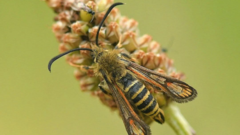
Conservationists conducting surveys at Rough Park, a local green space, have reported the exciting discovery of a rare six-belted clearwing moth. This uncommon sighting has not only highlighted the park's ecological value but has also sparked optimism among researchers who now hope to identify additional populations of the elusive insect within other nearby areas.
The six-belted clearwing, known scientifically as *Bembecia ichneumoniformis*, is a species that can be challenging to find due to its often localized distribution and its remarkable mimicry of wasps, a common defense mechanism. Its translucent wings and distinctive markings make it a visually unique insect, and its presence is often an indicator of specific habitat conditions, particularly the availability of its preferred larval food plants.
The discovery was made during routine monitoring efforts by conservationists dedicated to understanding and preserving local ecosystems. Rough Park, despite being an urban green space, clearly provides the necessary environment for such a specialized species to thrive, underscoring the importance of even seemingly small pockets of nature within populated areas for supporting biodiversity.
Clearwing moths, as a group, are fascinating due to their diurnal habits and their often vibrant, wasp-like appearance. The six-belted clearwing typically relies on particular host plants, often members of the pea family, for its larval stage. Its presence suggests that Rough Park maintains a healthy and diverse plant community capable of supporting a range of insect life, including these more sensitive species.
Following this significant find, researchers are eager to expand their surveys beyond Rough Park. The hope is that the discovery is not an isolated incident but rather evidence of a broader, previously unrecorded population across the region. Identifying further habitats for this rare moth could lead to enhanced conservation strategies for these areas.
The implications of such a discovery extend beyond just the moth itself. The presence of a rare species can often serve as an umbrella indicator for the health of an entire ecosystem. It suggests that the park's overall biodiversity is robust enough to sustain complex food webs, providing valuable insights into the ecological integrity of the local environment.
Future efforts are likely to include more intensive monitoring within Rough Park to better understand the moth's population dynamics and habitat use. Furthermore, public awareness campaigns might be initiated to engage local residents in protecting these vital green spaces, ensuring that discoveries like the six-belted clearwing moth continue to bring positive news for local wildlife.


Comments (0)
Be the first to comment.
Join the discussion