New Theory Suggests Black Holes Preserve Information, Offering Dual Insights into Physics
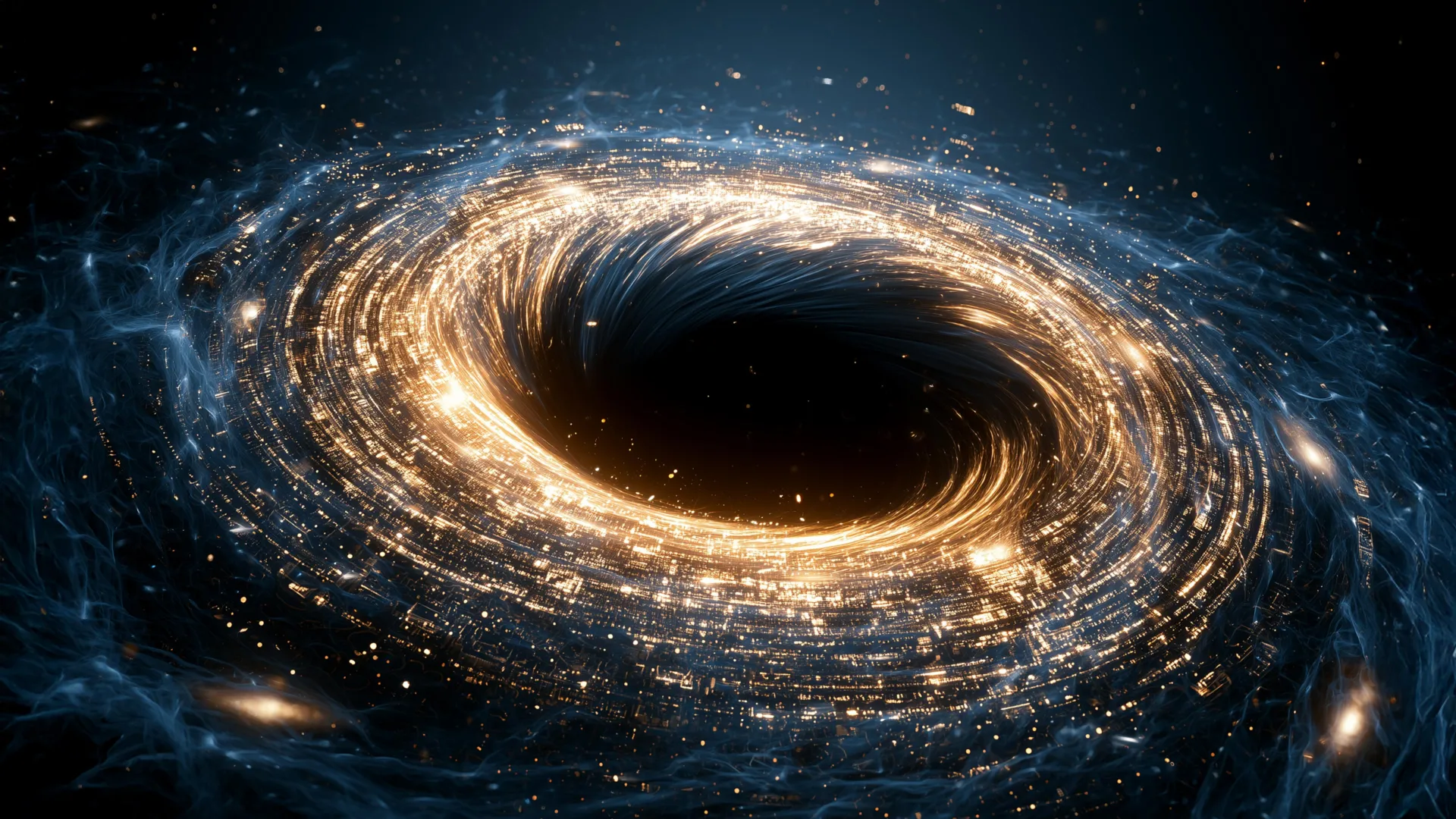
A breakthrough theoretical proposal by researchers suggests that the long-standing black hole information paradox may finally have a resolution. The new hypothesis posits that black holes do not fully evaporate, but instead leave behind minute remnants that safeguard all the information they once contained, preventing its loss from the universe.
For decades, physicists have grappled with the information paradox, a conundrum arising from the intersection of general relativity and quantum mechanics. Pioneering work by Stephen Hawking in the 1970s described how black holes emit 'Hawking radiation' and gradually shrink, eventually disappearing entirely. The paradox lay in the implication that if a black hole vanishes completely, the information about what fell into it would be irretrievably lost, violating a fundamental principle of quantum mechanics which dictates that information can never truly be destroyed.
The newly proposed solution offers a compelling alternative to this information loss. Rather than a complete disappearance, the theory suggests a critical point in the evaporation process where black holes cease their decay. This halt in evaporation is key to understanding how information might be preserved.
At this crucial juncture, the theory proposes that incredibly tiny, stable remnants are left behind. These 'ashes' of the black hole are not merely inert particles but are theorized to be the very structures that encode and retain all the intricate details of the matter and energy that originally formed the black hole, and subsequently fell into it.
Central to this groundbreaking idea is a sophisticated seven-dimensional geometry. This complex mathematical framework provides the theoretical underpinning for how these remnants can exist and effectively store information, offering a mechanism that bridges the gap between gravitational theory and quantum principles.
Intriguingly, the same seven-dimensional geometry that forms the basis of this black hole solution has another profound implication for fundamental physics. Researchers suggest that this mathematical structure could also provide an explanation for one of the universe's most basic mysteries: why elementary particles possess mass.
This dual potential makes the proposal particularly significant. If validated, it could not only resolve one of physics' most enduring paradoxes but also offer new insights into the fundamental properties of matter itself. While still a theoretical framework, it represents a substantial step toward a more unified understanding of the cosmos, from the smallest particles to the most enigmatic cosmic giants.


Comments (0)
Be the first to comment.
Join the discussion