Venus' Lower Atmospheric Haze Identified as Cosmic Dust, Study Finds
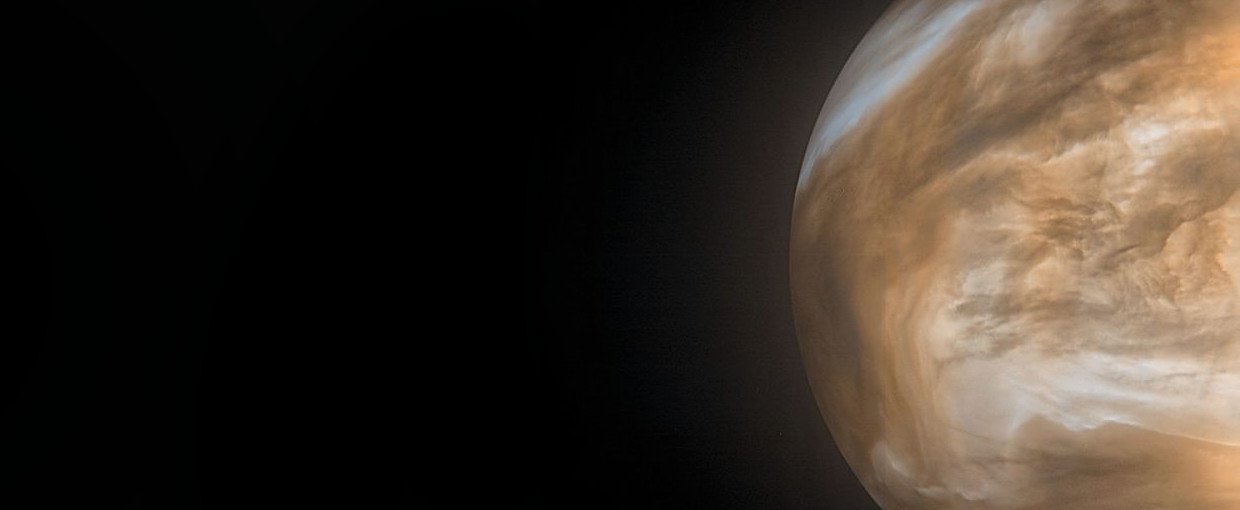
A new analysis of data from the 1970s Venera and Pioneer Venus missions has concluded that the planet's characteristic yellowish "lower haze" is composed primarily of fine cosmic dust rather than a unique atmospheric aerosol.
When the Soviet Venera landers and NASA's Pioneer Venus orbiter first captured images of the planet, they noted a persistent, dimly lit layer near the base of the cloud deck. At the time, scientists could only speculate about its makeup, labeling it a mysterious haze that distinguished Venus from other terrestrial worlds.
Researchers revisiting the original probe measurements with modern spectroscopic techniques have now identified the haze particles as sub‑micron silicate grains that match the composition of interplanetary dust that constantly drifts through the inner solar system. By comparing the wavelength‑dependent scattering signatures recorded by the probes with laboratory spectra of known dust materials, the team was able to rule out sulfuric acid droplets as the dominant component.
The presence of this extraterrestrial dust is consistent with Venus' strong gravitational pull and its thick atmosphere, which can capture particles that would otherwise burn up in Earth's higher‑altitude layers. Once trapped, the dust settles into the lower cloud region, where it remains suspended by turbulent winds, creating the faint yellow tint observed by the early spacecraft.
Understanding that the lower haze is largely dust has immediate implications for atmospheric modeling. Dust particles influence radiative transfer differently from sulfuric acid aerosols, affecting how sunlight is absorbed and re‑emitted. This, in turn, refines estimates of surface temperatures and the dynamics of the planet's super‑rotating winds.
The finding also reshapes how scientists view the exchange of material between planetary bodies. Venus, often considered an isolated extreme, now appears to participate in the solar system’s broader dust cycle, a process that may be mirrored on other worlds with dense atmospheres.
Future missions such as NASA's VERITAS and DAVINCI+ and ESA's EnVision are slated to carry advanced spectrometers capable of directly sampling the lower cloud region. Their observations will test the dust hypothesis further and could reveal how the influx of interplanetary material interacts with Venus' unique chemical environment.


Comments (0)
Be the first to comment.
Join the discussion