Cosmic Belches: New Observations Reveal Black Holes 'Digest' and Expel Matter
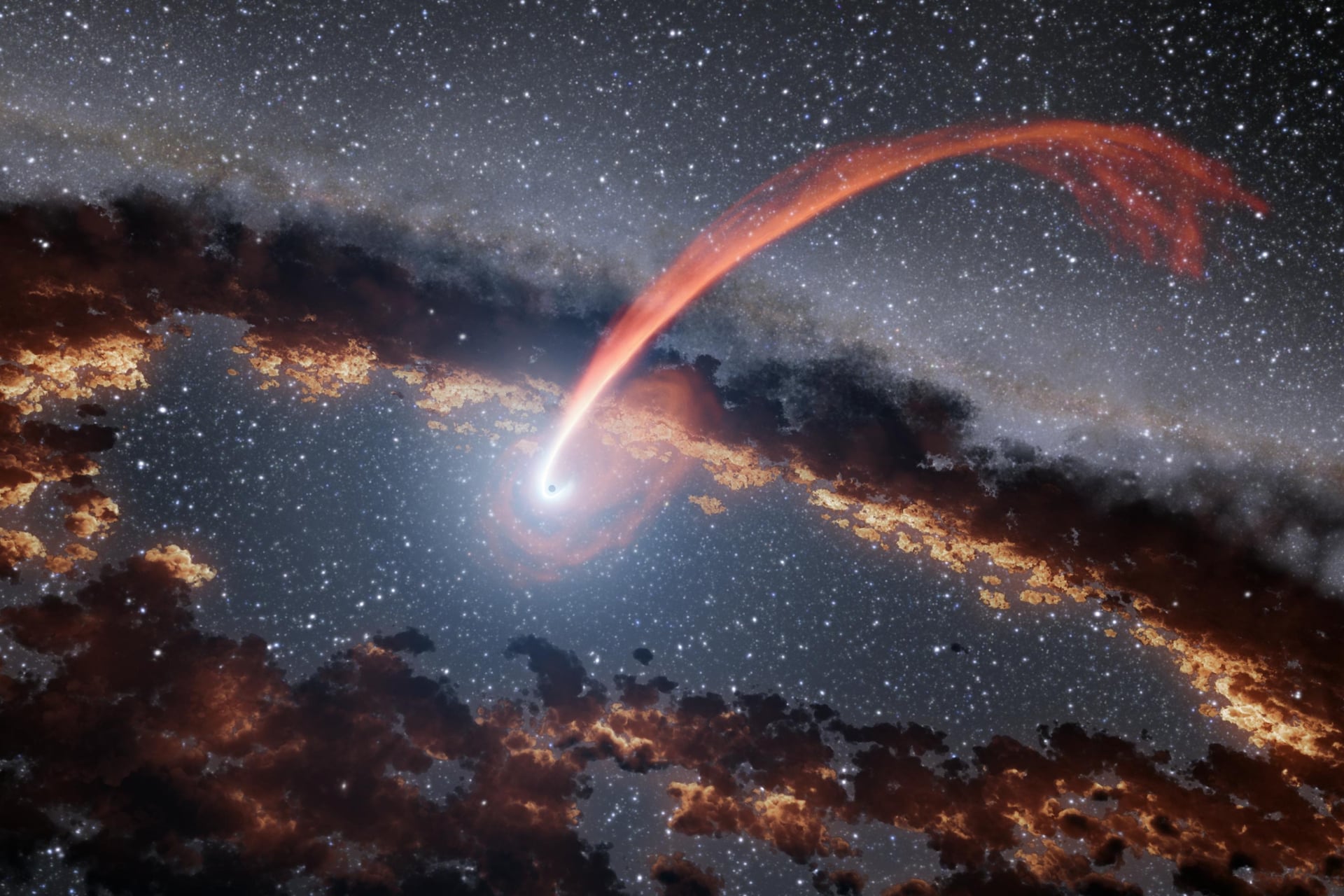
Astronomers are developing a more complex understanding of black holes, moving beyond the traditional image of them as simple cosmic devourers. Recent high-resolution observations suggest these enigmatic objects engage in intricate processes, likened to a 'digestive system,' which includes the expulsion of substantial amounts of gas.
For decades, black holes have been primarily conceptualized as gravitational behemoths, drawing in all matter and light that ventures too close to their event horizons. This view painted them as ultimate cosmic sinks, where anything captured was irreversibly lost into their depths.
However, a new high-resolution movie, capturing a black hole's interaction with surrounding material, offers a different perspective. This detailed visual evidence indicates that the process of accretion – where gas and dust spiral into a black hole – is far from a one-way street. Instead, it appears to involve dynamic internal mechanisms that can lead to significant outflows.
The metaphor of 'indigestion' or 'farts' in this context refers to these 'massive expulsions of gas.' Rather than cleanly consuming all incoming matter, black holes appear to process it, and during this activity, they can eject vast quantities of material. These expulsions are not insignificant; they represent powerful streams of energy and matter being propelled back into the surrounding space.
This revised understanding holds important implications for astrophysics. Such expulsions are thought to play a crucial role in shaping their host galaxies, influencing the rate of star formation, and distributing heavy elements across vast cosmic distances. The energy released during these 'digestive' events can heat gas clouds, preventing them from collapsing to form new stars, or conversely, compressing gas to trigger star birth.
The ability to capture such detailed observations marks a significant advancement in astronomical imaging. These sophisticated techniques are providing unprecedented insights into the dynamic environments around black holes, revealing the intricate interplay between these colossal objects and their immediate surroundings.
As researchers continue to analyze these high-resolution data sets, the aim is to refine our models of black hole behavior and their impact on cosmic evolution. The findings underscore that black holes are not merely passive absorbers but active participants in the ongoing transformation of the universe, constantly interacting with and reshaping their galactic homes through energetic outflows.



Comments (0)
Be the first to comment.
Join the discussion