Maxsun’s Z890 Mini‑ITX Workstation Uses Server‑Grade MCIO to Relocate GPU for Compact, External‑GPU‑Ready Design
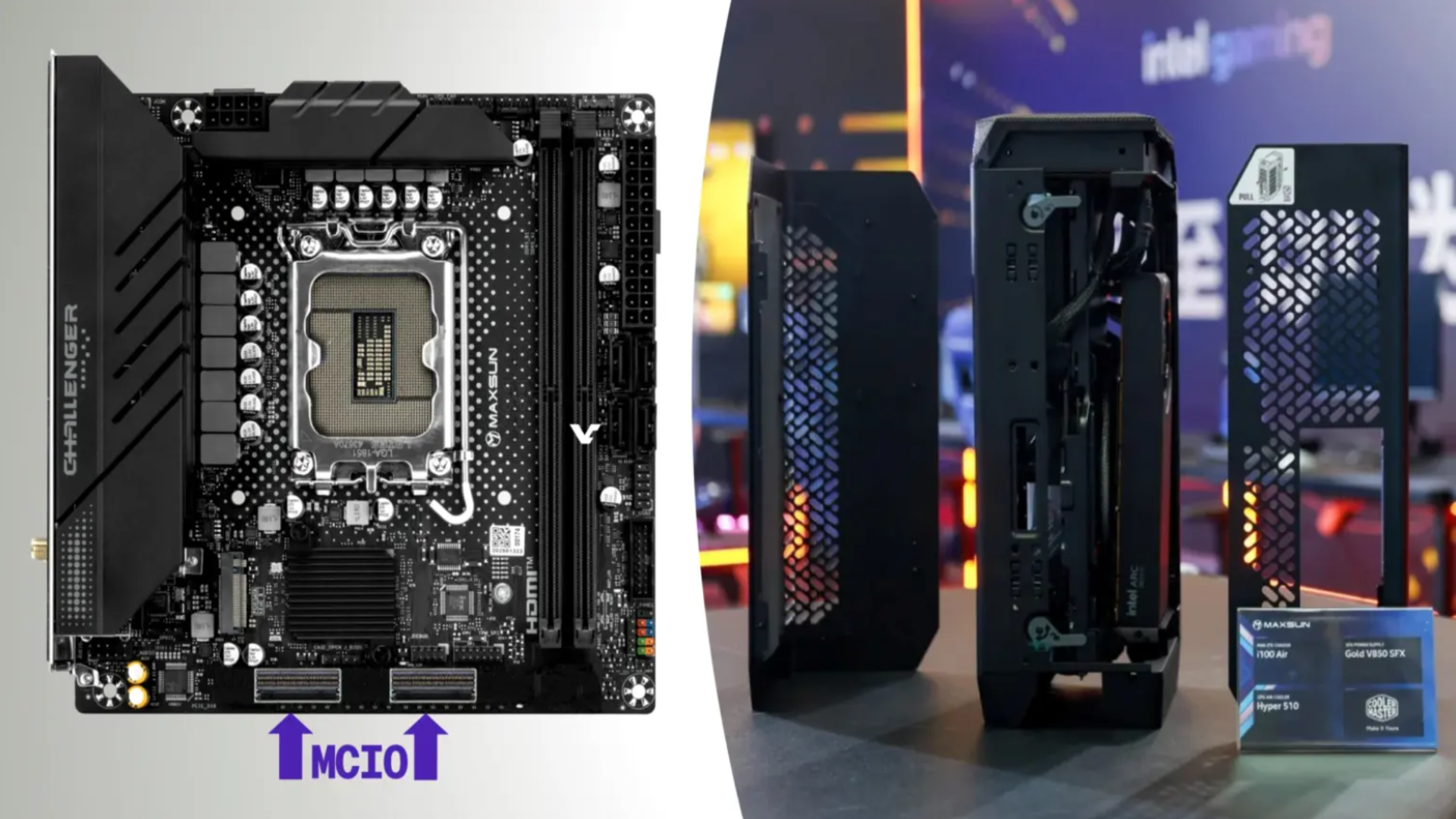
Chinese PC maker Maxsun has unveiled the Z890 Mini‑ITX workstation, a compact system that eliminates the traditional on‑board graphics card slot by leveraging a server‑derived interconnect called MCIO. The move lets the motherboard and GPU occupy opposite sides of the chassis, opening a path for external graphics solutions in a form factor that previously struggled with high‑performance video needs.
MCIO – short for Multi‑Chip I/O – originates in enterprise server architecture where it links separate compute modules over high‑speed lanes. Maxsun adapted the technology to a consumer‑grade workstation, using it as a dedicated bridge between the mainboard and a discrete GPU housed in a separate enclosure. By shifting the graphics processor away from the board, the Z890 can maintain a slim profile without sacrificing PCIe bandwidth.
In practice, the Z890’s motherboard sits on one side of the case while a detachable GPU module attaches to the opposite side via the MCIO link. The design removes the need for a conventional PCIe x16 slot, freeing up space for additional components or a smaller chassis altogether. Users can snap a GPU into place, disconnect it for transport, or replace it with a newer model without opening the entire system.
The platform supports several PCIe lane configurations, ranging from x8 to full x16, depending on the MCIO implementation chosen. This flexibility allows system integrators to balance performance and power consumption, tailoring the workstation to tasks from 3D rendering to AI inference. Because the GPU communicates over a dedicated high‑speed link, latency remains comparable to that of an on‑board card, according to Maxsun’s technical brief.
Industry observers note that the Z890 could reshape the small‑form‑factor workstation market, where thermal constraints and limited expansion have long been obstacles to high‑end graphics. By externalising the GPU, manufacturers can offer powerful rendering capability without the bulk of a traditional tower, appealing to designers, engineers, and content creators who need portability.
Maxsun has not disclosed pricing, but the company plans to ship the Z890 later this year, targeting professional users who value both compactness and upgradeability. If the MCIO approach proves reliable, it may encourage other OEMs to adopt similar server‑inspired interconnects, potentially accelerating the broader shift toward modular, external GPU ecosystems in the consumer and prosumer space.



Comments (0)
Be the first to comment.
Join the discussion