Voyager 1 Reaches One‑Light‑Day Milestone, Signal Takes Full Day to Reach Probe
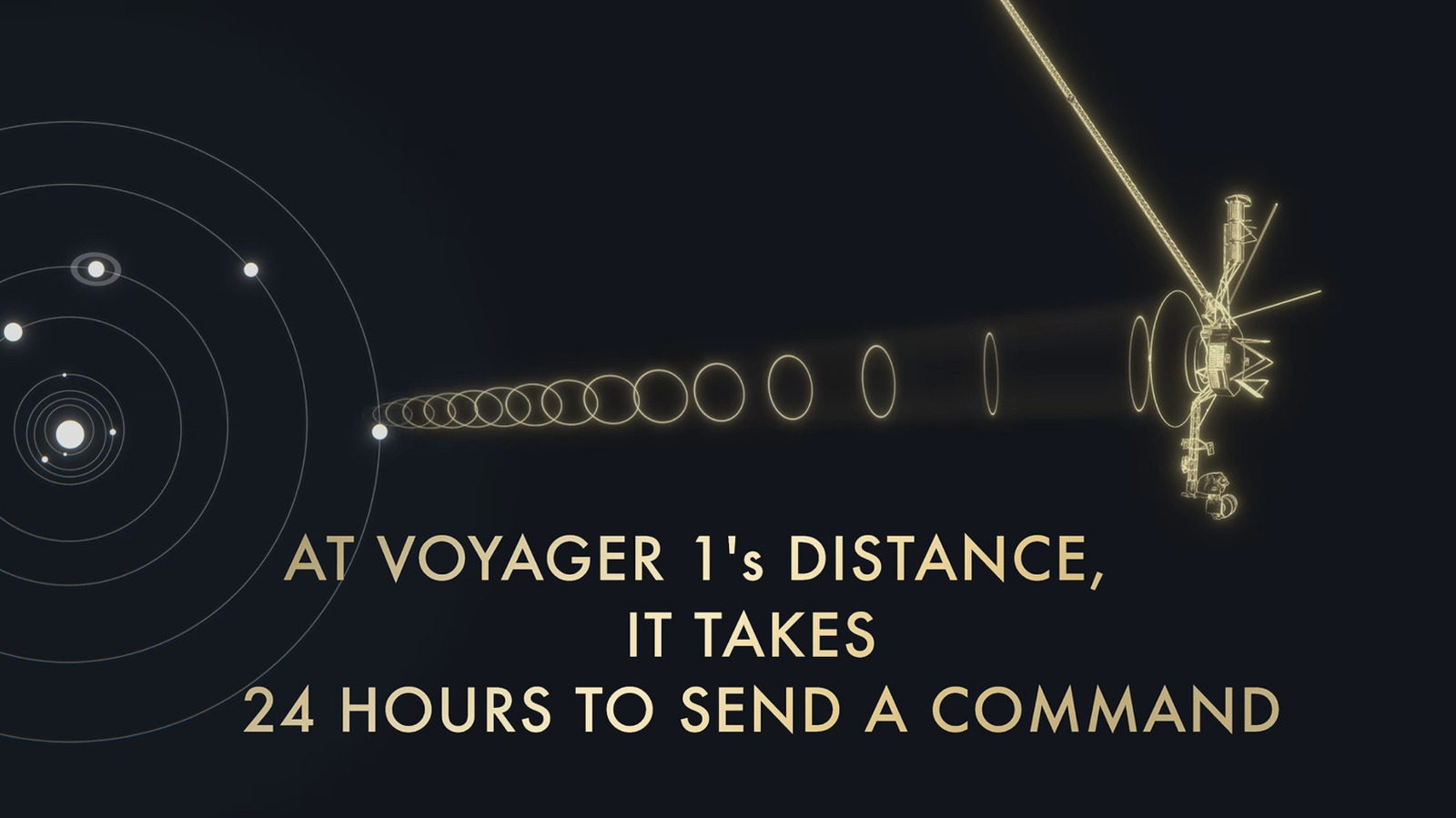
NASA's Voyager 1 has crossed a new distance marker, now sitting roughly one light‑day from Earth, meaning a radio transmission takes about 24 hours to travel to the spacecraft. The milestone was confirmed by mission controllers this week and highlights that the probe, launched more than four decades ago, continues to push the limits of human‑made exploration.
The twin Voyager spacecraft were launched in 1977 to take advantage of a rare planetary alignment, delivering close‑up images of Jupiter and Saturn before continuing on trajectories that would eventually carry them out of the solar system. Voyager 1, the faster of the pair, completed its flyby of the outer planets and entered interstellar space in 2012, becoming the first human artifact to do so.
A light‑day corresponds to the distance light travels in 24 hours, roughly 26 billion kilometres (about 16 billion miles). At this range Voyager 1 sits well beyond the orbit of Pluto and even the heliopause, the boundary where the Sun’s solar wind yields to the interstellar medium. The probe’s current distance is a reminder that it is now more than 150 AU from the Sun, a figure that has steadily increased each year.
Communicating with a spacecraft at such a distance is a technical feat. NASA’s Deep Space Network, a global array of 70‑metre and 34‑metre antennas, must lock onto a signal that is billions of times weaker than a typical broadcast. The one‑day travel time for a message means that any command sent to Voyager 1 cannot be confirmed until a full day later, and any data returned—such as measurements of cosmic rays—arrives after a similar delay.
Voyager 1 is powered by three radio‑isotope thermoelectric generators (RTGs) that convert the heat from decaying plutonium‑238 into electricity. Over the decades the output has fallen to a few hundred watts, just enough to run the spacecraft’s transmitter and a handful of instruments. Engineers estimate that the RTGs will no longer provide sufficient power sometime in the late 2020s, at which point the mission will be formally concluded.
Despite the dwindling energy budget, the probe continues to send valuable science. Its plasma wave sensor records the density of charged particles in interstellar space, while its magnetometer maps the magnetic field that threads the galaxy. These data sets, collected far beyond any other human‑made platform, help refine models of the heliosphere’s interaction with the surrounding medium.
Looking ahead, NASA plans to keep the probe operational as long as power permits, with occasional software updates sent from Earth to prioritize the most critical instruments. When the signal finally fades, Voyager 1 will remain a silent ambassador drifting through the galaxy, its golden record still attached as a time capsule of Earth’s culture.
The achievement underscores how a mission conceived in the 1970s can still shape scientific understanding today. As other deep‑space concepts, such as the Interstellar Probe, move from study to development, Voyager’s longevity offers both a benchmark and an inspiration for future generations seeking to send humanity’s voice farther into the cosmos.



Comments (0)
Be the first to comment.
Join the discussion