Hubble Captures Emerging Decagonal Jet Encircling Saturn’s South Pole
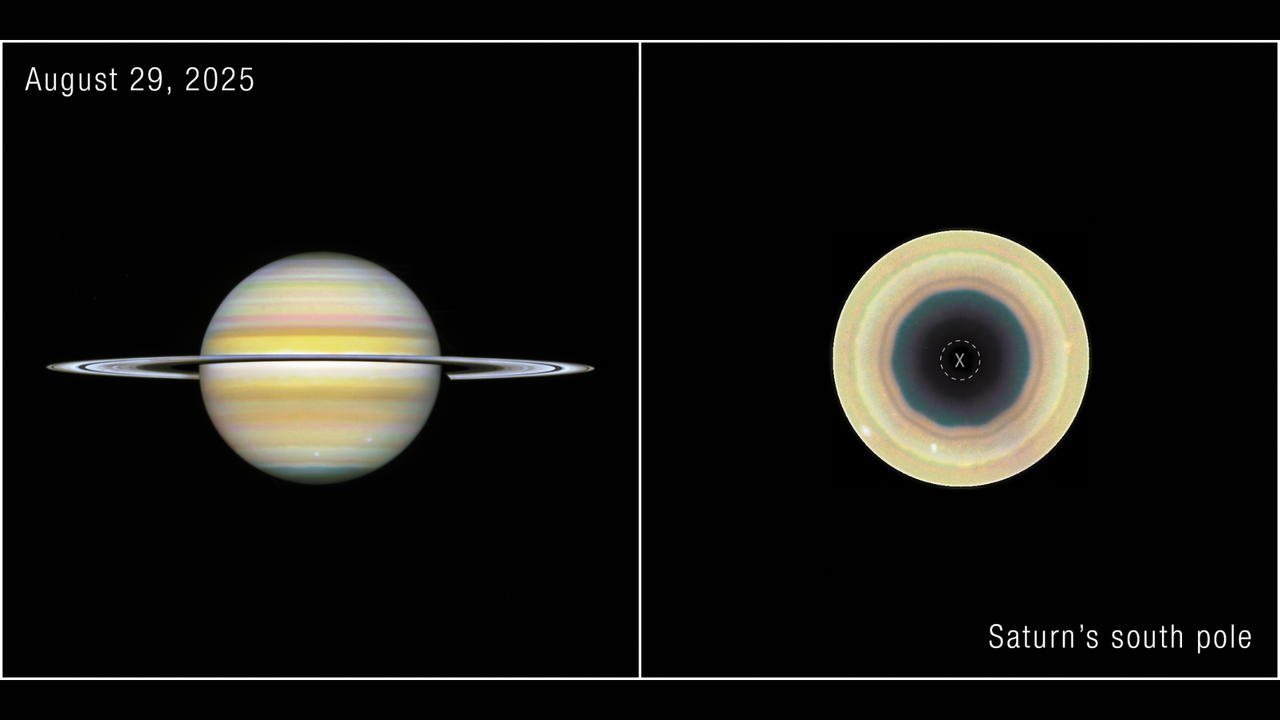
A new set of images from the Hubble Space Telescope shows a ten‑sided atmospheric wave forming around Saturn’s south pole, a structure that appears to be developing in real time.
The high‑resolution view, taken in visible light, reveals a striking decagonal pattern that surrounds the polar vortex. Observations taken over several weeks indicate that the edges of the shape are shifting, suggesting that the feature is evolving as the planet rotates.
Saturn’s poles have long fascinated scientists because of their unusual jet streams. The north pole is famous for a persistent hexagonal jet discovered by Voyager and later studied in detail by the Cassini mission. By contrast, the southern pole has shown a more subdued vortex, and the appearance of a decagon adds a new layer to the planet’s atmospheric complexity.
The emergence of a ten‑sided wave is significant because it points to changes in the dynamics of Saturn’s upper atmosphere. Seasonal variations—Saturn is currently moving away from its southern summer—can alter temperature gradients and wind speeds, potentially giving rise to standing wave patterns that manifest as geometric shapes.
Planetary scientists note that such polygonal structures are thought to arise from standing Rossby waves trapped in the planet’s stratosphere. While models have predicted a range of possible shapes, the decagon is the first clear example observed at the south pole, and researchers are cautious about drawing firm conclusions without further data.
Future monitoring by Hubble, combined with infrared observations from the James Webb Space Telescope, aims to track the feature’s evolution and probe its vertical structure. With the Cassini mission concluded, Earth‑based telescopes now play a crucial role in unveiling the ongoing mysteries of Saturn’s atmospheric behavior.


Comments (0)
Be the first to comment.
Join the discussion