Hubble Image of NGC 6723 Reveals Unexpected Stellar Pattern in the ‘Chandelier’ Cluster
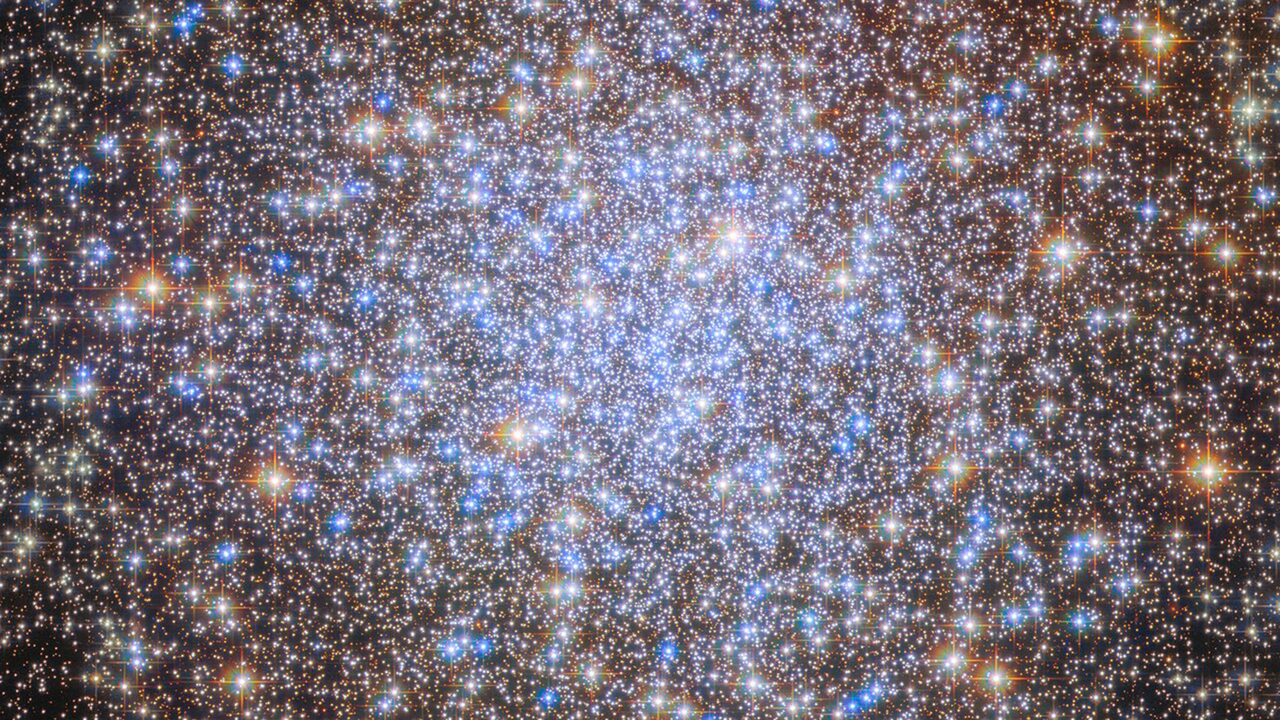
A new high‑resolution photograph taken by the Hubble Space Telescope has highlighted an odd arrangement of bright stars in NGC 6723, a globular cluster often called the “Chandelier Cluster,” prompting astronomers to revisit assumptions about the structure of such ancient stellar systems.
NGC 6723 resides roughly 27,000 light‑years from Earth in the direction of the Sagittarius constellation. Like other globular clusters, it is a densely packed, spheroidal collection of old stars that orbits the Milky Way’s halo and offers a living record of the galaxy’s early formation era.
The Hubble image, released as this week’s “Space Photo of the Week,” shows a striking configuration of luminous stars that appear to hang like ornaments from an invisible framework. While globular clusters are typically expected to display a fairly smooth, centrally concentrated brightness profile, the apparent “chandelier” pattern in NGC 6723 does not match the standard models of a relaxed, spherical system.
Scientists note that such irregularities could signal a number of underlying processes, ranging from past gravitational encounters with the Milky Way’s disk to internal dynamical events that have reshaped the cluster’s core. Because globular clusters serve as benchmarks for stellar evolution, any deviation from expected structure may provide clues about the Milky Way’s merger history or the long‑term dynamical evolution of dense star groups.
The discovery will likely spur follow‑up observations using both space‑based instruments and large ground‑based observatories. Detailed spectroscopic studies could reveal whether the anomalous stars differ in composition or motion from the rest of the cluster, while future imaging from the James Webb Space Telescope may resolve finer details of the cluster’s inner regions. For now, the Hubble snapshot adds a fresh puzzle to the study of one of our galaxy’s oldest residents, reminding researchers that even well‑charted celestial objects can still surprise.


Comments (0)
Be the first to comment.
Join the discussion