ESA’s Hera Mission Set to Examine DART Impact Site on Binary Asteroids in November
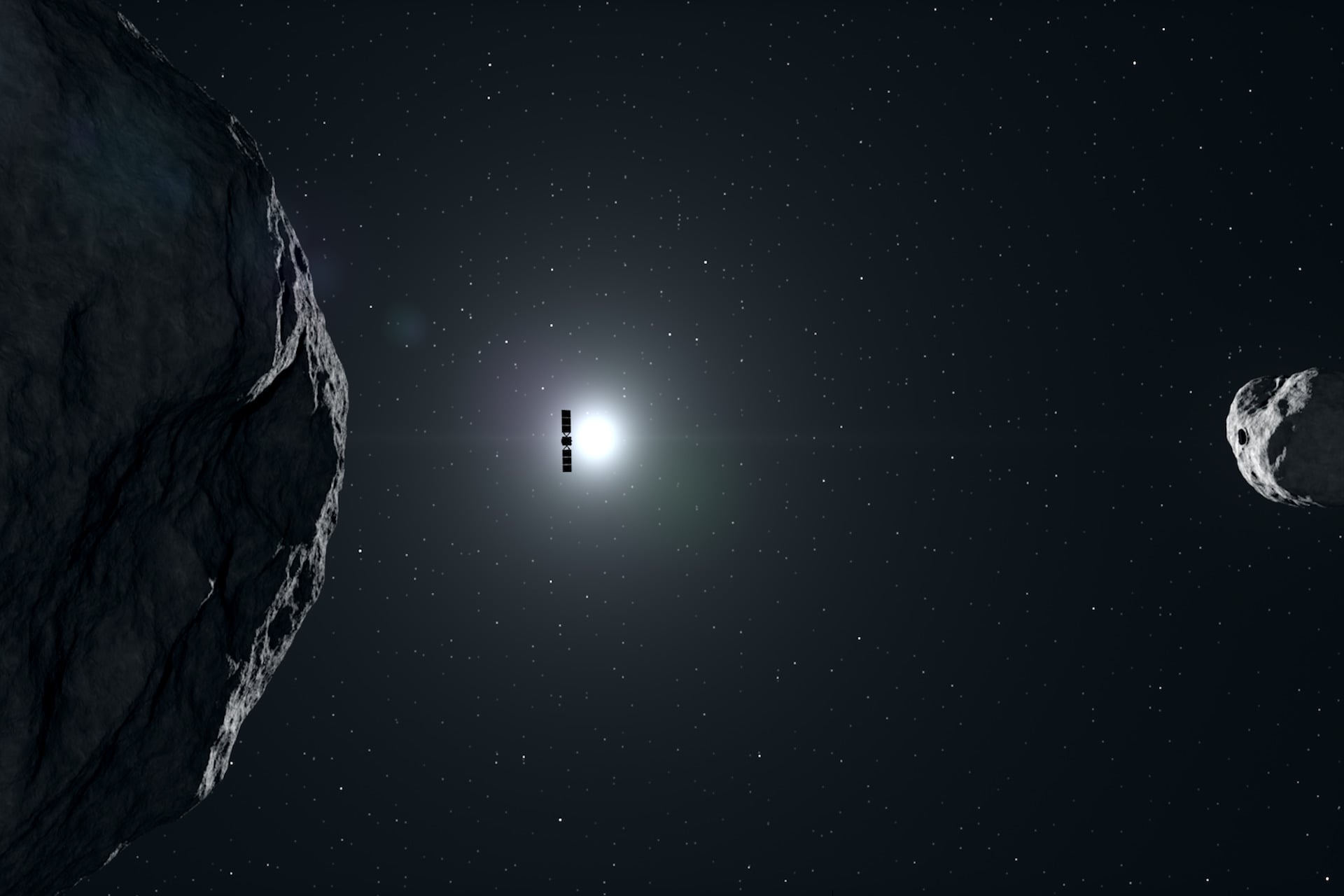
Europe's Hera spacecraft is on track to meet the Didymos binary asteroid system this November, positioning itself to conduct the first detailed inspection of the crater left by NASA's Double Asteroid Redirection Test (DART) mission. The rendezvous will allow scientists to directly assess the damage inflicted on Dimorphos, the smaller moon of the near‑Earth asteroid Didymos, after DART’s kinetic‑impact experiment in September 2022.
Hera, part of the joint Asteroid Impact and Deflection Assessment (AIDA) collaboration between the European Space Agency (ESA) and NASA, carries a suite of high‑resolution cameras, a lidar instrument, and a low‑frequency radar. These tools will map the surface topography of both Didymos and Dimorphos, measure the size and morphology of the impact crater, and quantify any changes in the moon’s orbit caused by the strike. The data are expected to refine estimates of how much momentum was transferred during the impact, a critical factor for future planetary‑defence strategies.
The DART mission, launched in 2021, was the first intentional attempt to alter an asteroid’s trajectory by colliding a spacecraft with it. While ground‑based telescopes confirmed that Dimorphos’s orbit shortened by several minutes, the precise mechanics of the momentum transfer remain uncertain. Hera’s close‑up observations will fill that gap, offering a ground‑truth check on models that predict the effectiveness of kinetic impactors against potentially hazardous objects.
Beyond the immediate scientific goals, Hera’s findings will feed into broader international efforts to develop reliable deflection techniques. The European Space Agency plans to use the mission’s results to inform the design of future missions that could protect Earth from larger, more dangerous asteroids. By characterising the material properties of the asteroid pair and the post‑impact debris environment, Hera will help determine whether kinetic impacts can be scaled up or combined with other methods such as gravity tractors or laser ablation.
Hera’s launch in October 2024 and its subsequent cruise to the Didymos system have been closely followed by the planetary‑defence community. The November encounter marks a milestone not only for the AIDA partnership but also for the emerging field of asteroid mitigation. As the spacecraft approaches the binary system, mission controllers will begin a series of close‑range observations that are expected to continue for several months, providing a comprehensive dataset that could shape the next generation of planetary‑protection policies.



Comments (0)
Be the first to comment.
Join the discussion