Green‑Glowing White Dwarf Revealed After Devouring Its Own Planets
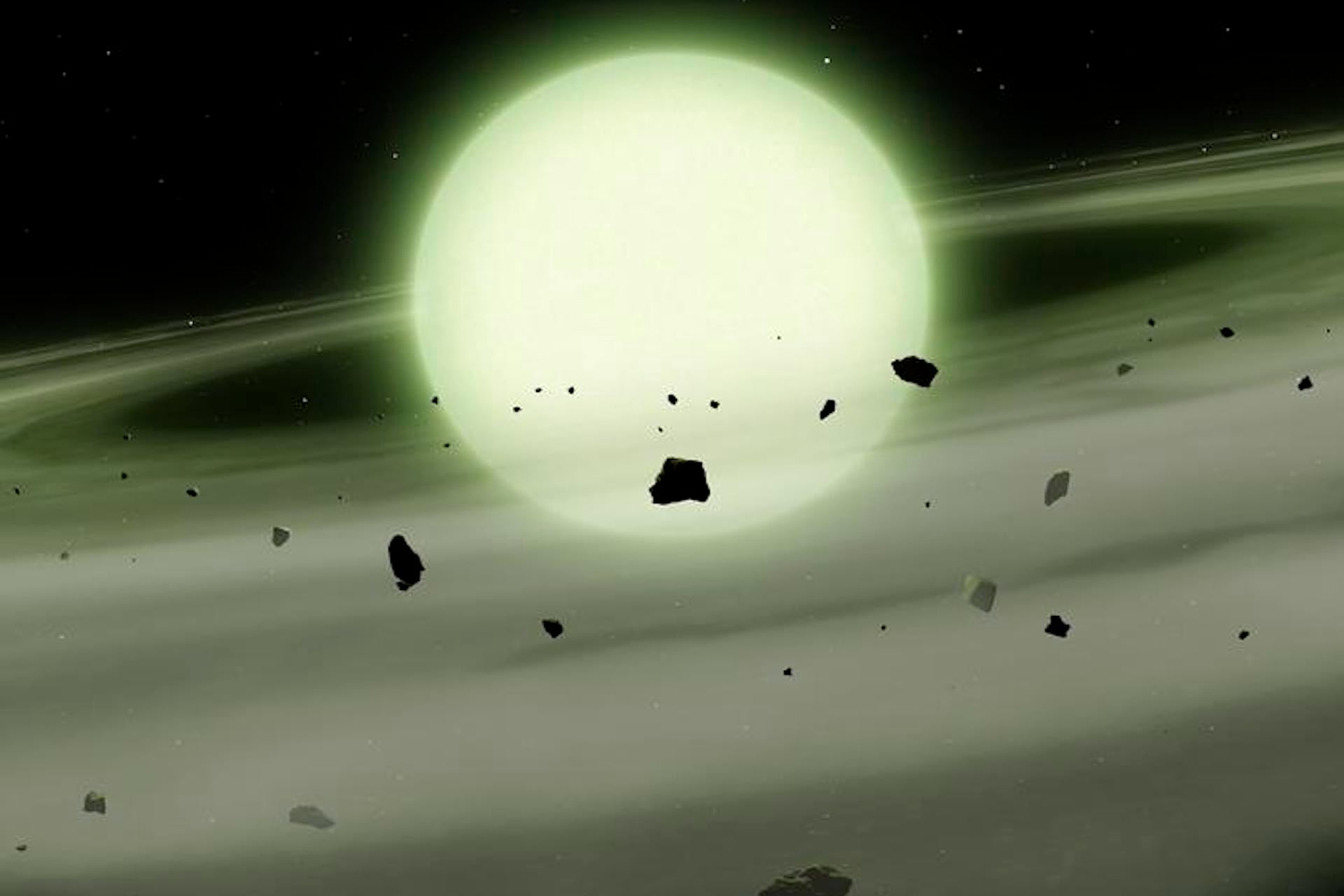
Astronomers have identified the first white dwarf whose light appears green, a hue that emerged after the star consumed the remnants of its planetary system, marking a novel addition to the catalog of stellar colors.
White dwarfs are the dense, cooling cores left behind when Sun‑like stars exhaust their nuclear fuel. Their surface temperatures typically emit a white or bluish glow, reflecting the high-energy radiation that remains as they fade. The newly observed star, however, deviates from this norm, displaying a distinct green tint that has never been recorded in a white dwarf before.
Scientists attribute the unusual coloration to the infusion of heavy elements stripped from engulfed planets. As the dying star expands, it can pull in nearby planetary bodies; their disintegration deposits metals such as calcium, iron and magnesium onto the white dwarf’s surface. These metals alter the star’s spectrum, producing emission lines that, when combined, shift the visible output toward green wavelengths.
The same observations also revealed faint pink and purple tones surrounding the green core, suggesting a complex mixture of elements and temperatures within the star’s atmosphere. The discovery was made with high‑resolution spectrographs mounted on ground‑based observatories, which captured the star’s light across a broad range of wavelengths and allowed researchers to isolate the spectral signatures responsible for the color shift.
Beyond its visual novelty, the finding challenges prevailing assumptions about the chemical purity of white dwarf atmospheres. Traditionally, astronomers have regarded these remnants as largely composed of hydrogen or helium, with only trace contaminants. The presence of enough planetary debris to dominate the star’s visible spectrum implies that planetary engulfment may be more common—and more chemically impactful—than previously thought.
Future work will focus on monitoring the green dwarf for changes in its spectrum, searching for similar objects in archival data, and refining models of how planetary material mixes into white dwarf envelopes. If additional green, pink or purple white dwarfs are identified, the phenomenon could become a new diagnostic tool for studying the fate of planetary systems after their host stars die.


Comments (0)
Be the first to comment.
Join the discussion