Bolt Graphics Achieves First Live Test of Its Zeus Simulation GPU
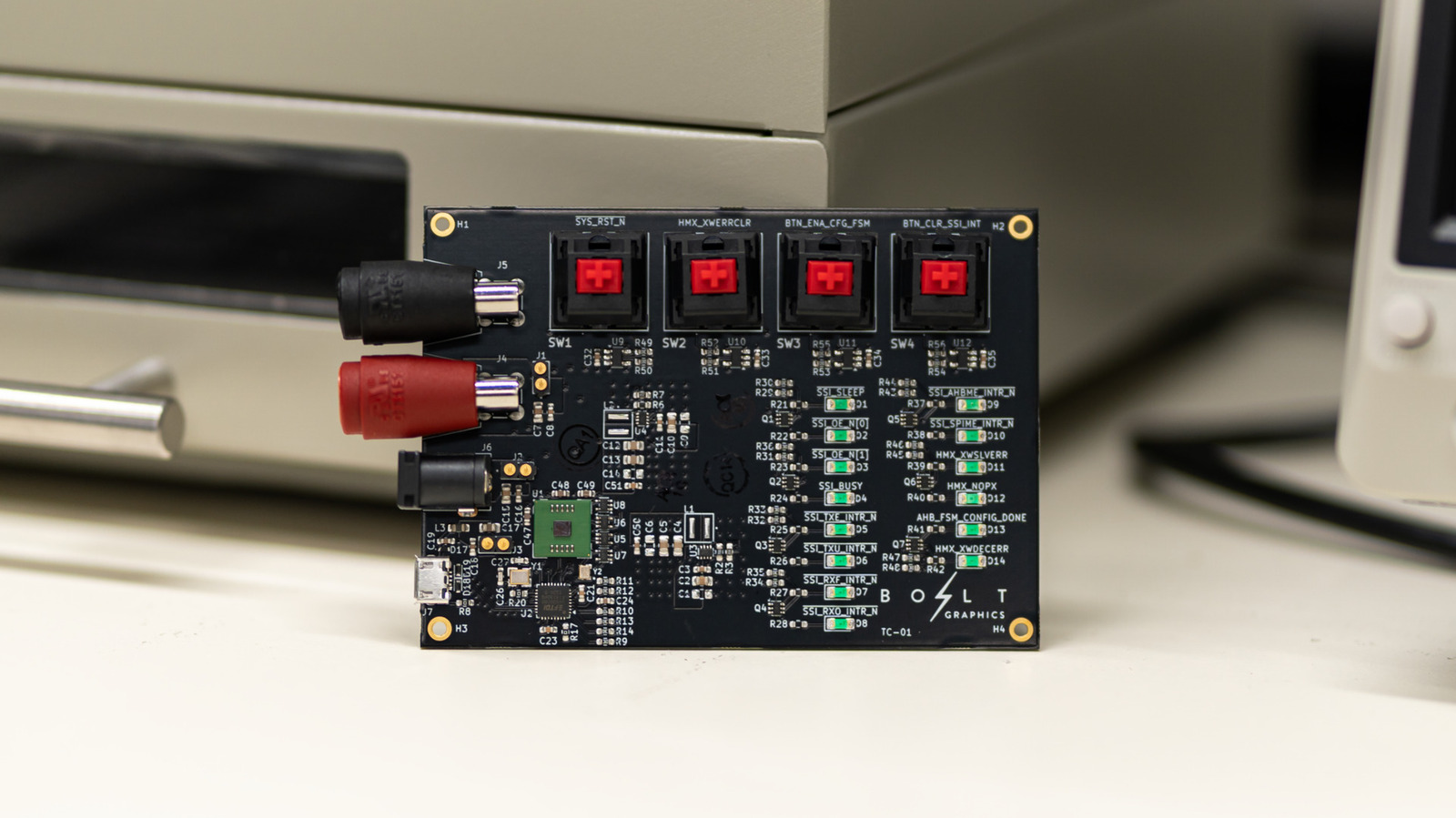
Bolt Graphics announced that its long‑awaited Zeus graphics processor has successfully powered on for the first time, marking a critical milestone in the company’s effort to deliver a GPU built specifically for high‑fidelity simulation workloads.
The Zeus chip, described by the firm as "simulation‑centric," has been under development for several years. Unlike conventional graphics processors that balance gaming performance with compute tasks, Zeus is engineered to accelerate complex physics, fluid dynamics and AI‑driven modeling, areas that demand massive parallelism and deterministic output.
In a brief statement, Bolt Graphics said the test run confirmed the processor’s basic functionality and demonstrated that its custom silicon can sustain the power and thermal envelopes required for sustained simulation workloads. The company did not disclose performance numbers, but the successful power‑on suggests that the design’s core subsystems – including its proprietary memory hierarchy and scheduler – are operating as intended.
The achievement arrives at a time when the market for specialized accelerators is expanding. Companies in automotive, aerospace and scientific research are increasingly looking for hardware that can handle real‑time simulation for autonomous driving, virtual prototyping and climate modeling. By positioning Zeus as a dedicated solution rather than a general‑purpose GPU, Bolt hopes to carve out a niche in these high‑value segments.
Industry observers note that bringing a new GPU from concept to silicon is a costly and technically demanding process, often dominated by a handful of large players. Bolt’s progress demonstrates that smaller firms can still innovate by focusing on narrow, high‑impact use cases. Analysts will be watching how quickly the company can move from a successful power‑on to broader validation, driver support and integration with popular simulation frameworks.
Looking ahead, Bolt Graphics indicated that further testing will evaluate Zeus under realistic workloads, with plans to release a development kit later this year. If those trials confirm the chip’s promised capabilities, the company could begin courting early adopters in sectors that demand precise, high‑throughput simulation. For now, the successful boot‑up stands as a tangible sign that the Zeus project is moving beyond the laboratory and toward commercial readiness.



Comments (0)
Be the first to comment.
Join the discussion